
For international audiences exploring Chinese culture, the Qixi Festival—known widely as China’s Double Seventh Festival, falling on the 7th day of the 7th month of the traditional lunar calendar—is often mislabeled as a direct equivalent of Western Valentine’s Day. While modern celebrations include romantic gestures, the holiday has roots stretching back over 2,000 years, tied to ancient astronomical observations, folk mythology, and traditional customs that reflect core Chinese values around love, family, and diligence.
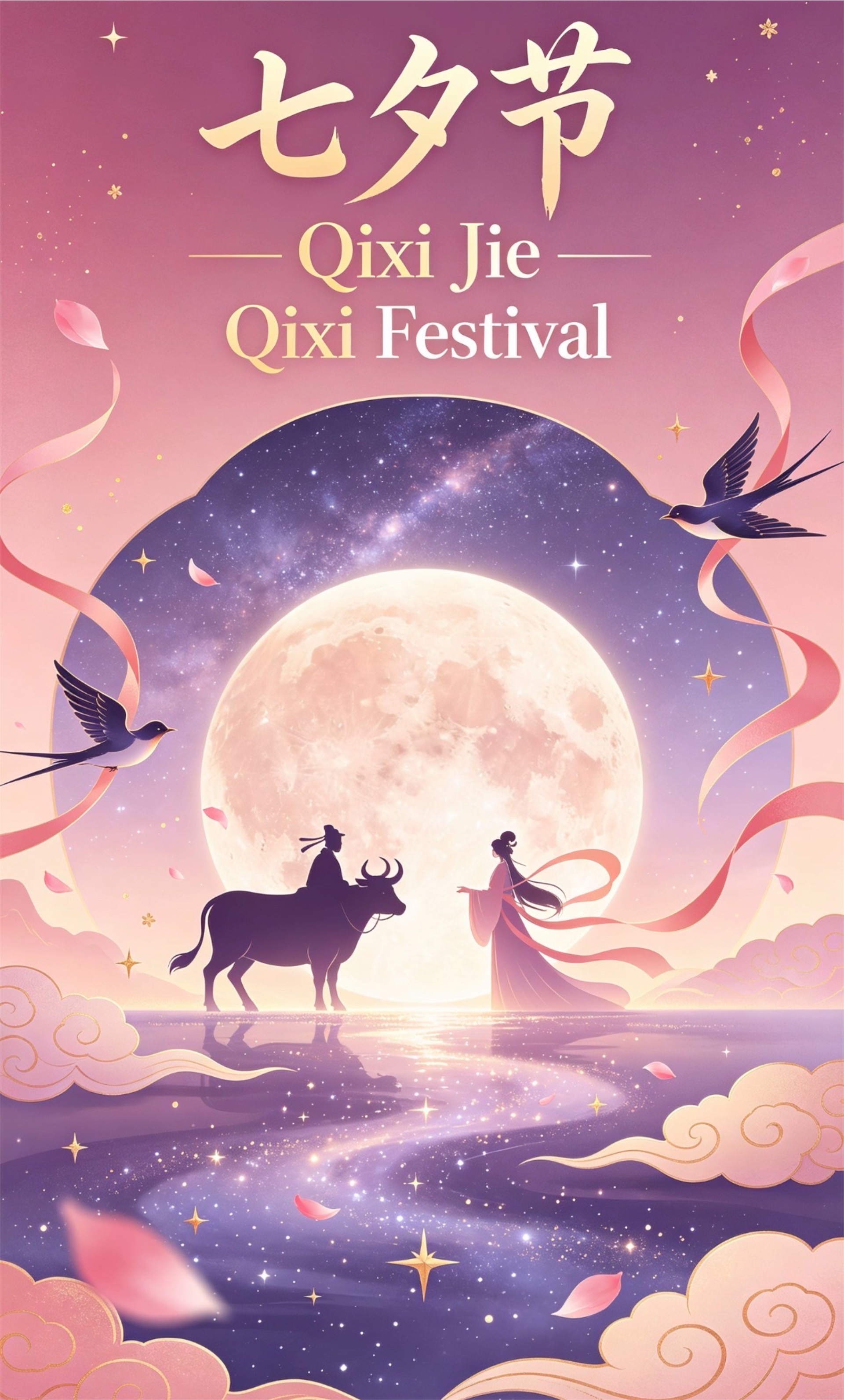
The most well-known origin story of Qixi centers on the myth of the Cowherd (Niulang) and the Weaver Girl (Zhinü), one of China’s four great folk legends. Per the tale, the Weaver Girl, a skilled weaver of heavenly clouds, descended to the mortal world, fell in love with a kind cowherd, and married him, living a happy life farming and weaving together. When the heavenly queen discovered their union, she separated the pair with a vast river of stars—the Milky Way—allowing them to meet only once a year, on the 7th day of the 7th lunar month, when a flock of magpies forms a bridge across the sky to reunite them. Early iterations of the festival date back to the Han Dynasty, when people held ceremonies to honor the Weaver Girl, praying for deft needlework skills, good fortune, and happy marriages.
Traditional Qixi customs vary across regions of China, but many center on skill-blessing activities for young women. Historically, girls would hold thread-threading contests under the evening light, display handmade crafts and seasonal fruits as offerings, and pray to the Weaver Girl for talent in weaving, sewing, and household arts, as well as for a loving, stable marriage. Other traditional practices include hanging colorful silk threads, collecting morning dew from plant leaves (believed to carry the Weaver Girl’s blessing for clear eyes and steady hands), and observing the two bright stars flanking the Milky Way—Vega (representing the Weaver Girl) and Altair (representing the Cowherd)—on the festival night. Unlike Western romantic holidays that focus heavily on gift-giving between partners, traditional Qixi emphasized community, family well-being, and wishes for personal skill and good fortune.
In modern China, Qixi has evolved to incorporate romantic celebrations, leading to its common nickname as “Chinese Valentine’s Day.” Couples often mark the day with date nights, flower exchanges, special meals, and small gifts, and many brands launch limited-edition products or promotions tied to the holiday. Even so, many communities still preserve traditional customs: cultural events, folk craft fairs, and reenactments of the ancient thread-threading and offering ceremonies are held in cities and rural villages alike, connecting modern celebrants to the festival’s long history. The holiday also remains a popular subject in Chinese poetry, art, and pop culture, with references to the Cowherd and Weaver Girl appearing in everything from classical Tang Dynasty poems to modern television shows and songs.
A common misconception among international observers is that Qixi is a modern, commercial invention created to mirror Western Valentine’s Day. In reality, the festival’s written records date back over 2,000 years, and its romantic association has developed gradually over centuries, rather than being a recent marketing construct. Another key difference from Western Valentine’s Day is that Qixi’s core narrative centers on enduring commitment and reunion after separation, rather than the courtship themes central to the Western holiday. It is also important to note that Qixi falls on a different date each year on the Gregorian calendar, usually between late July and late August, as it follows the traditional Chinese lunar calendar rather than the solar calendar used for most international business and daily scheduling.
For global teams, media professionals, and cross-cultural partners working with Chinese organizations or audiences, understanding Qixi offers a window into core Chinese cultural values: the importance of long-term loyalty, the value of skill and diligence, and the balance between romantic connection and family and community bonds. For international learners building Mandarin language skills to engage with Chinese culture and business contexts, learning about traditional festivals like Qixi supports more nuanced, respectful cross-cultural communication, whether collaborating with Chinese colleagues, connecting with Chinese customers, or exploring Chinese cultural heritage.
At Chinese Begin, the international Mandarin education platform from Wuhan Zhongwen Qihang Education Technology Co., Ltd., structured cultural context is integrated into Mandarin courses for international learners, university partners, and enterprise clients. Learners build practical listening, speaking, reading, and writing skills while exploring real cultural contexts, from traditional festivals to modern business communication norms, with support for HSK 1-3 exam preparation, scheduled live classes, and self-paced practice tools to build confident, culturally fluent Mandarin skills.